primary conclusion of what is it like to be a bat

Thomas Nagel argues that while a human might exist able to imagine what it is like to be a bat past taking "the bat'south point of view", information technology would all the same be impossible "to know what it is like for a bat to be a bat." (Townsend'southward big-eared bat pictured).
"What Is It Like to Be a Bat?" is a paper by American philosopher Thomas Nagel, first published in The Philosophical Review in October 1974, and subsequently in Nagel's Mortal Questions (1979). The paper presents several difficulties posed by consciousness, including the possible insolubility of the mind-trunk problem owing to "facts beyond the reach of human being concepts", the limits of objectivity and reductionism, the "phenomenological features" of subjective experience, the limits of human imagination, and what it means to be a detail, conscious thing.[1]
Nagel famously asserts that "an organism has conscious mental states if and only if there is something that it is like to be that organism—something it is like for the organism."[ii] This assertion has achieved special status in consciousness studies as "the standard 'what it'due south similar' locution."[3] Daniel Dennett, while sharply disagreeing on some points, best-selling Nagel'south paper as "the nearly widely cited and influential thought experiment about consciousness."[4] : 441
Thesis [edit]

Nagel challenges the possibility of explaining "the most important and characteristic feature of conscious mental phenomena" by reductive materialism (the philosophical position that all statements nigh the mind and mental states can be translated, without any loss or alter in meaning, into statements about the physical). For example, a reductive physicalist's solution to the mind–body problem holds that any "consciousness" is, it can exist fully described via physical processes in the brain and body.[5]
Nagel begins by assuming that "conscious experience is a widespread miracle" present in many animals (peculiarly mammals), fifty-fifty though information technology is "hard to say [...] what provides testify of it." Thus, Nagel sees consciousness non as something exclusively human, but every bit something shared by many, if not all, organisms. Nagel must be speaking of something other than sensory perception, since objective facts and widespread testify bear witness that organisms with sensory organs take biological processes of sensory perception. In fact, what all organisms share, according to Nagel, is what he calls the "subjective character of feel" divers as follows: "An organism has conscious mental states if and merely if there is something that information technology is similar to be that organism – something that it is like for the organism."[1]
The paper argues that the subjective nature of consciousness undermines any endeavour to explain consciousness via objective, reductionist means. The subjective graphic symbol of experience cannot be explained past a organisation of functional or intentional states. Consciousness cannot exist fully explained if the subjective character of experience is ignored, and the subjective character of experience cannot be explained by a reductionist; it is a mental miracle that cannot be reduced to materialism.[6] Thus, for consciousness to be explained from a reductionist stance, the idea of the subjective grapheme of experience would have to be discarded, which is absurd. Neither can a physicalist view, because in such a globe each phenomenal experience had past a conscious being would have to have a concrete property attributed to it, which is incommunicable to show due to the subjectivity of conscious feel. Nagel argues that each and every subjective experience is connected with a "unmarried point of view", making it infeasible to consider any conscious feel as "objective".
Nagel uses the metaphor of bats to clarify the distinction between subjective and objective concepts. Because bats are mammals, they are assumed to accept conscious experience. Nagel was inspired to use a bat for his argument after living in a domicile where the animals were frequent visitors. Nagel ultimately used bats for his argument because of their highly evolved and active use of a biological sensory appliance that is significantly unlike from that of many other organisms. Bats apply echolocation to navigate and perceive objects. This method of perception is like to the human sense of vision. Both sonar and vision are regarded as perceptual experiences. While it is possible to imagine what information technology would exist like to fly, navigate past sonar, hang upside downwards and consume insects similar a bat, that is non the same as a bat's perspective. Nagel claims that even if humans were able to metamorphose gradually into bats, their brains would non accept been wired as a bat's from nativity; therefore, they would just exist able to feel the life and behaviors of a bat, rather than the mindset.[7]
Such is the deviation between subjective and objective points of view. According to Nagel, "our ain mental activity is the only unquestionable fact of our experience", meaning that each private just knows what it is like to be them (subjectivism). Objectivity requires an unbiased, non-subjective state of perception. For Nagel, the objective perspective is not viable, because humans are express to subjective experience.
Nagel concludes with the contention that it would be wrong to presume that physicalism is incorrect, since that position is besides imperfectly understood. Physicalism claims that states and events are physical, but those physical states and events are only imperfectly characterized. Withal, he holds that physicalism cannot be understood without characterizing objective and subjective feel. That is a necessary precondition for understanding the heed-trunk trouble.
Criticisms [edit]
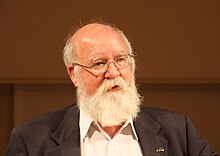
Daniel Dennett denies Nagel's merits that the bat's consciousness is inaccessible, contending that any "interesting or theoretically important" features of a bat's consciousness would be acquiescent to 3rd-person observation.[iv] : 442 For instance, it is articulate that bats cannot find objects more than than a few meters away because echolocation has a express range. Dennett holds that any similar aspects of its experiences could be gleaned by farther scientific experiments.[four] : 443 Kathleen Akins similarly argued that many questions about a bat's subjective experience hinge on unanswered questions about the neuroscientific details of a bat'south brain (such as the part of cortical activity profiles), and Nagel is too quick in ruling these out as answers to his central question.[viii] [ix]
Peter Hacker analyzes Nagel's statement every bit not merely "malconstructed" but philosophically "misconceived" as a definition of consciousness,[10] and he asserts that Nagel's paper "laid the groundwork for…forty years of fresh confusion about consciousness."[xi] : thirteen
Eric Schwitzgebel and Michael Southward. Gordon have argued that, contrary to Nagel, normal sighted humans exercise utilize echolocation much similar bats - it is just that it is generally washed without one's awareness. They utilize this to argue that normal people in normal circumstances can be grossly and systematically mistaken about their conscious experience.[12]
See also [edit]
- Brute consciousness
- Intersubjectivity
- Qualia
- Umwelt
References [edit]
- ^ a b Nagel, Thomas (x March 2005). Honderich, Ted (ed.). The Oxford Companion to Philosophy. Oxford: Oxford University Press. p. 637. ISBN978-0-19-103747-iv.
- ^ Nagel, Thomas (1974). "What Is It Like to Be a Bat?". The Philosophical Review. 83 (4): 435–450. doi:ten.2307/2183914. JSTOR 2183914.
- ^ Levine, Joseph (2010). Review of Uriah Kriegel, Subjective Consciousness: A Self-Representational Theory. Notre Dame Philosophical Reviews 2010 (3).
- ^ a b c Dennett, Daniel C. (1991). Consciousness Explained. Boston: Niggling, Brown and Company.
- ^ Wimsatt, William C (1976). Reductionism, Levels of Arrangement, and the Listen-Body Problem. Springer US. pp. 205–267. ISBN978-1-4684-2198-9.
- ^ "Qualia | Net Encyclopedia of Philosophy". www.iep.utm.edu . Retrieved 2015-06-01 .
- ^ De Preester, Helena (2007). "The deep bodily origins of the subjective perspective: Models and their problems". Consciousness and Knowledge. xvi (three): 604–618. doi:ten.1016/j.concog.2007.05.002.
- ^ Bickle, John; Mandik, Peter; Landreth, Anthony. "The Philosophy of Neuroscience". Stanford Encyclopedia of Philosophy. Stanford. Retrieved 2 September 2020.
Kathleen Akins (1993a) delved deeper into existing knowledge of bat physiology and reports much that is pertinent to Nagel'south question. She argued that many of the questions most bat subjective experience that we still consider open hinge on questions that remain unanswered nigh neuroscientific details. One case of the latter is the office of various cortical activeness profiles in the active bat.
- ^ Akins, Kathleen (1993). "What is it Like to be Boring and Myopic". In Dahlbom, Bo (ed.). Dennett and His Critics: Demystifying Mind (PDF). Cambridge, MA: Basil Blackwell. p. 125-160. ISBN0-631-18549-6.
- ^ Hacker, P.M.S. (2002). "Is there anything it is similar to be a bat?" (pdf). Philosophy. 77: 157–174. doi:10.1017/s0031819102000220.
- ^ Hacker, P.Chiliad.South. (2012). "The Sad and Sorry History of Consciousness: being, among other things, a challenge to the "consciousness-studies community"" (pdf). Majestic Institute of Philosophy. supplementary volume 70.
- ^ Schwitzgebel, Eric; Gordon, Michael Due south. (2000). "How Well Do We Know Our Own Conscious Experience?: The Example of Human Echolocation". Philosophical Topics. 28 (two): 235–246.
Further reading [edit]
- "What is it like to be a bat?". Philosophical Review. LXXXIII (iv): 435–450. Oct 1974. doi:10.2307/2183914.
- Hacker, P.M.S. (2002). "Is there anything it is like to exist a bat?" (pdf). Philosophy. 77: 157–174. doi:10.1017/s0031819102000220.
- Schwitzgebel, Eric (2020-12-23). "Is At that place Something It's Like to Exist a Garden Snail?" (PDF).
{{cite web}}: CS1 maint: url-status (link)
merrittdidettioners.blogspot.com
Source: https://en.wikipedia.org/wiki/What_Is_It_Like_to_Be_a_Bat%3F
0 Response to "primary conclusion of what is it like to be a bat"
Post a Comment